
<?xml version="1.0" encoding="UTF-8"?>
<rss version="2.0">


	<channel>
		<title><![CDATA[Juridica International: Vol. IX]]></title>
		<link>http://www.juridicainternational.eu/index.php?id=10547</link>
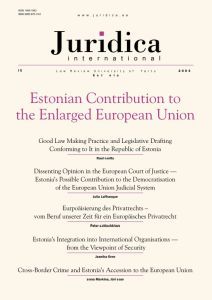
		<description><![CDATA[Estonian Contribution to the Enlarged European Union]]></description>
		<language>en</language>
		
																																																																																				
		<lastBuildDate>Wed, 01 Apr 2009 23:20:25 +0300</lastBuildDate>
		
									
				<item>
			<title><![CDATA[cover]]></title>
			
			<link>http://www.juridicainternational.eu/index.php?id=14810</link>
			
			<description><![CDATA[<p><a href="http://www.juridicainternational.eu/public/covers/ji_2004_1_cover.jpg" rel="lightbox">
<img vspace="0" hspace="0" border="0" alt="" src="http://www.juridicainternational.eu/public/covers/ji_2004_1_cover_tn.jpg" />
</a>
</p>]]></description>						<guid>http://www.juridicainternational.eu/?id=14810</guid> 
			<pubDate>Mon, 19 Sep 2011 00:00:00 +0300</pubDate>
		</item>
						
				<item>
			<title><![CDATA[Determination of the Level of Environmental Protection and the Proportionality of Environmental Measures in Community Law]]></title>
			
			<link>http://www.juridicainternational.eu/index.php?id=12623</link>
			
			<description><![CDATA[<h2>1. Formulation of problem</h2> <p align="justify">Under international law, every state has the freedom to choose such level of protection of its citizens and environment as is deemed appropriate. The desired level of protection may differ widely from country to country. This can also be clearly seen in the European Union, where, in respect of a high level of environmental measures, more environment-friendly member states have often had to overcome the opposition of those member states which care less about environmental protection. The latter have often been able to block or at least ‘cushion’ or postpone the adoption of such measures. While priorities regarding the environment are different even among European states, the situation is far more serious throughout the rest of the world, where the attention of developing countries often does not reach environmental problems at all because they have to focus their efforts too much on economic and social issues.<sup>*1</sup> Within the framework of the WTO, developing countries have continuously expressed their concern of being discriminated by the pressure to adopt the high level of environmental protection applied in the developed countries. In my opinion, Estonia, too, tends to belong to the group of those countries where economic and social considerations are clearly prioritised, at least in practice.</p> <p align="justify">In many candidate states of the European Union, the pre-referendum debates have involved the question of to what extent the state would, as a member of the European Union, retain its right to determine the level of protection of its citizens and environment. In other words, there is the problem of whether a European Union&nbsp;member state can enact and apply environmental measures which are stricter or softer than those laid down in Community&nbsp;directives.</p> <a href="/index.php?id=12623">More...</a>]]></description>						<guid>http://www.juridicainternational.eu/?id=12623</guid> 
			<pubDate>Wed, 01 Apr 2009 00:00:00 +0300</pubDate>
		</item>
						
				<item>
			<title><![CDATA[Restrictions on Active Legal Capacity]]></title>
			
			<link>http://www.juridicainternational.eu/index.php?id=12621</link>
			
			<description><![CDATA[<p align="justify">In connection with the strengthening and enlargement of the European Union, the development of EU law and its harmonisation with the national law of the member states becomes increasingly important and topical. Harmonised regulation is particularly necessary in areas relevant to communication between persons from different states. Contract law, for which many model laws have been drafted<sup>*1</sup> and which also has a central role in the European Civil Code currently being prepared, has been in the foreground for good reason. In relation to contract law, consumer protection law has been the focus of European Union law, so as to ensure the equal and fair treatment of consumers. Estonia’s new civil law was drafted in great consideration of these developments in European law, particularly as regards the General Part of the Civil Code Act<sup>*2</sup> (GPCCA) and the Law of Obligations Act<sup>*3</sup> (LOA), which entered into force on 1 July 2002. The active legal capacity of natural persons is an area to which adequate attention has not yet been paid from the standpoint of harmonisation of the law of the various EU member states. In connection with the principle of free movement of persons, capital, goods, and services in the EU, more attention should be paid to the issues concerning the active legal capacity of natural persons and ways to harmonise the relevant regulation. In particular, this concerns protection of the rights of persons with restricted active legal capacity, but it also relates to protection of the rights of any party who enters into a transaction with such a person. Major development has occurred in Estonia in this area. The GPCCA effective since 1 July 2002 replaced the former GPCCA, which entered into force on 1 September 1994<sup>*4</sup> (referred to below as the former GPCCA), whereas one of the main changes introduced in the new act of Parliament, which is a supplemented version of the former GPCCA, is the amended regulation of the active legal capacity of natural persons.</p> <p align="justify">The purpose of this article is to analyse regulation concerning the restricted active legal capacity of natural persons in Estonia, based on the major legal amendments of 2002; the article also compares the Estonian law in this area with that of other European Union states and makes proposals for harmonisation of the regulation within the European Union. The relevant regulation of any particular state cannot be analysed in greater detail in this article. Therefore, the examples of particular states are discussed only insofar as necessary for general conclusions. The legal systems compared are: the Germanic family of law, the Roman family of law and common law, as well as Scandinavian law. The aim of the authors is to develop discussion in this area, which could contribute to the prospective harmonisation of regulation related to restricted active legal capacity in the European Union.</p> <a href="/index.php?id=12621">More...</a>]]></description>						<guid>http://www.juridicainternational.eu/?id=12621</guid> 
			<pubDate>Wed, 01 Apr 2009 00:00:00 +0300</pubDate>
		</item>
						
				<item>
			<title><![CDATA[Cross-Border Crime and Estonia’s Accession to the European Union]]></title>
			
			<link>http://www.juridicainternational.eu/index.php?id=12619</link>
			
			<description><![CDATA[<h2>1. Introduction</h2> <p align="justify">The issues of cross-border crime<sup>*2</sup> related to Eastern Europe were already topical before the current enlargement of the European Union. The majority of foreign criminologists and experts claim that crimes between the East and the West have increased considerably, diversified, and become more ‘organised’ over the decades, with radical social change and broadening crime opportunities.<sup>*3</sup> What will happen in cross-border crime after the accession of the ten countries, including Estonia and other former Soviet republics, is a question to which various answers have been given.</p> <p align="justify">Cross-border crime related to Estonia and the other Baltic states has mainly been examined in the context of the movement of offenders from these countries to the European Union and the resulting worsening of the crime situation in the old member states.<sup>*4</sup> Such stereotypical assessment is rather prevalent both in Western European public opinion and among law enforcement professionals.<sup>*5</sup> Here we can perceive the transfer of similar views to new circumstances, or unwillingness to alter earlier attitudes. This is illustrated by an organised crime report for 2002 prepared by Europol, which concludes among other things that Estonian organised crime groups have fully taken over the role of drug traffickers to Finland.<sup>*6</sup> Such an attitude is also manifested in the image of the (Russian) mafia, which has been created to emphasise the extreme danger accompanying the offenders from the ‘new’ states.<sup>*7&nbsp;</sup></p> <a href="/index.php?id=12619">More...</a>]]></description>						<guid>http://www.juridicainternational.eu/?id=12619</guid> 
			<pubDate>Wed, 01 Apr 2009 00:00:00 +0300</pubDate>
		</item>
						
				<item>
			<title><![CDATA[Estonia’s Integration into International Organisations - from the Viewpoint of Security]]></title>
			
			<link>http://www.juridicainternational.eu/index.php?id=12618</link>
			
			<description><![CDATA[<p align="justify">The <st1:PlaceType>Republic</st1:PlaceType> of <st1:PlaceName>Estonia</st1:PlaceName> has been a full member state of the North Atlantic Treaty Organisation since <st1:date Year="2004" Day="29" Month="3">29 March 2004</st1:date>,Estonia is the full member state of the European Union since <st1:date Year="2004" Day="1" Month="5">1 May 2004</st1:date>. These developments are in testimony of a huge step towards a free, whole and peaceful Europe.<sup>*1</sup> For the acceding states, accession to both these organisations means supranational integration in security issues, as has also meant the accession to other security organisations, such as the Western European Union (WEU), the Organisation for Security and Co-operation in Europe (OSCE) and the United Nations (UN).</p> <p align="justify">From historical viewpoint — as a small state that has been occupied many times — security guarantees are essential to Estonia. The pursuit of independence, territorial integrity and cultural identity has accompanied the development of the Estonian nation. Although the author sees neither military nor political threats aiming to change Estonia’s internal or external policies today or in the near future, she is aware of and understands that the state must be ready to combat such threats as economic, social and environmental risks, international crime, and terrorism.</p> <a href="/index.php?id=12618">More...</a>]]></description>						<guid>http://www.juridicainternational.eu/?id=12618</guid> 
			<pubDate>Wed, 01 Apr 2009 00:00:00 +0300</pubDate>
		</item>
						
				<item>
			<title><![CDATA[Good Law Making Practice and Legislative Drafting Conforming to It in the Republic of Estonia]]></title>
			
			<link>http://www.juridicainternational.eu/index.php?id=12615</link>
			
			<description><![CDATA[<h2>1. Regulatory practice and new legislation </h2> <p align="justify">Legislation is not conducted, nor laws created, merely for providing legislative institutions with work. Neither can legislation be aimed at a relatively narrow circle of society. Legislative work and the law have been and are almost the only means available to states through which the conduct of the major part of society can be regulated.<sup>*1</sup>Such perception and recognition of the role of legislation in society requires that due regard be paid to several factors in legislative drafting in order to ensure quality. Most broadly, these factors can be divided into the technical (related to regulatory practice) and substantive (<i>ius</i><i>estarsboni et aequi</i>).</p> <p align="justify">The regulatory rules of legislative drafting comprise a set of measures and methods, justified on the basis of theory, used in preparing drafts of legislative acts. Regarded as such, regulatory measures form an inseparable part of the procedure of legislative drafting and help ensure the validity and effect of the legislative act adopted.<sup>*2</sup> In the Estonian legal order, the regulatory issues have been considered so important that on 28 September 1999, the government adopted Regulation 279, ‘Regulatory rules of draft legislative acts’<sup>*3</sup>, which entered into force on 1 January 2000.<sup>*4</sup> The objective of the regulation was to guarantee a certain uniformity and quality of draft legislative acts through establishing the principal regulatory rules. The regulation was amended on <st1:date Year="2001" Day="20" Month="11">20 November 2001</st1:date>. The regulation has not been amended further thereafter, and hence to date, we may speak about a certain developed practice as regards preparation of legislative acts. This concerns the main requirements for draft legislation, the main requirements for amending or repealing legislation, and requirements for the explanatory memoranda to be appended to drafts. In addition, the rules provide requirements for the regulations of the Government of the Republic and the various ministries.</p> <p align="justify">Yet it is clear that a legislative act can be used for providing general requirements. The author of the foreword to the recently published ‘Handbook of Regulatory Practice’, the present Minister of Justice, correctly says: ‘Real life is much more varied, and while implementing general provisions we may still face the fact that problems cannot be solved merely by legislative acts.’<sup>*5 </sup></p> <a href="/index.php?id=12615">More...</a>]]></description>						<guid>http://www.juridicainternational.eu/?id=12615</guid> 
			<pubDate>Wed, 01 Apr 2009 00:00:00 +0300</pubDate>
		</item>
						
				<item>
			<title><![CDATA[European and Estonian Law of Obligations - Transposition of Law or Mutual Influence?]]></title>
			
			<link>http://www.juridicainternational.eu/index.php?id=12614</link>
			
			<description><![CDATA[<h2>1. Estonian Law of Obligations Act in the context of unification of European law</h2> <p align="justify">Changes in the legal system do not always result from the countries’ free choice but from international competition and political coercion countereffects.<sup>*1</sup>Besides the export of culture and goods, globalisation has brought about also the transformation of law. The success of transformation of society largely depends on how effectively the existing legal system can be reformed, the role that transplants from other legal orders and systems acquire in the existing legal framework, and how they are understood in the context of generally recognised legal traditions and the developed legal culture.<sup>*2</sup> Mapping of the existing traditions has sometimes been regarded as a crucial prerequisite for harmonisation of law<sup>*3</sup>, but in a situation where globalisation has transformed the legal culture into a very rapidly changing and dynamic phenomenon, this task seems unfeasible and difficult to follow. Today, it is not only the methods and scope of transposition of rules that are of interest but also the substance of the rules or the meaning that a particular provision has acquired in a specific cultural environment. The following discussion covers some of the most important legal transplants in the Law of Obligations Act (LOA), their sources, and the issues that have arisen and may arise in the future in giving substance to these provisions. Estonia has an intriguing chance of influencing the formation of common European civil law by introducing its experience in the transformation of unified civil law principles and rules into the national legal system. </p> <a href="/index.php?id=12614">More...</a>]]></description>						<guid>http://www.juridicainternational.eu/?id=12614</guid> 
			<pubDate>Wed, 01 Apr 2009 00:00:00 +0300</pubDate>
		</item>
						
				<item>
			<title><![CDATA[Dissenting Opinion in the European Court of Justice - Estonia’s ­Possible Contribution to the Democratisation of the European Union Juridcial System]]></title>
			
			<link>http://www.juridicainternational.eu/index.php?id=12612</link>
			
			<description><![CDATA[<h2>1. Introduction. Dissenting opinions in the Supreme Court of Estonia</h2> <p align="justify">Estonia has become a member of the European Union. In relation to this, two Estonian judges work in the European Union court system and participate in supranational administration of justice in the European Court of Justice (ECJ) and the Court of First Instance of the European Communities. The judicial practice of the ECJ will definitely benefit from the experience that these judges have gained during their careers in the courts of Estonia, a country that restored democracy not long ago and has, among other things, built up a state based on the rule of law, characterised by ample reform legislation. But there is yet another link between the administration of justice in Estonia and that in the European Union — Estonian courts and judges have become a part of the judicial power of the European Union. Time will tell what the dialogue between the Estonian courts and the ECJ will be like; it is too early to predict how active the Estonian courts will be in seeking preliminary rulings from the ECJ. The co-operation will no doubt be mutually enriching; not only will administration of justice in Estonia become more ‘European’, but the European Union is in turn likely to find something worth transposing from Estonia. </p> <p align="justify">I would like to focus on one such possible aspect of the Estonian legal system — the opportunity for a judge to present a dissenting opinion. The disclosure of a judge’s dissent from the majority opinion is permitted in Estonian court judgements, but this is not allowed in judgements of the ECJ. The European Union as a whole has been criticised for lacking democracy in its judgement procedure, and the criticism is likely justified, considering how decisions are made in the ECJ. A smooth integration of the new member states into the body of the established members may come under threat when democracy is lacking. The admissibility of dissenting opinions in the ECJ is an issue that has remained intriguing as nobody dares to attempt to change the <i>status quo </i>of the ECJ, and thus it has become a taboo area for experts in European law. This article attempts to take pioneering strides in this field and serves as a dissenting opinion on the disallowance of dissenting opinions in the ECJ. </p> <a href="/index.php?id=12612">More...</a>]]></description>						<guid>http://www.juridicainternational.eu/?id=12612</guid> 
			<pubDate>Wed, 01 Apr 2009 00:00:00 +0300</pubDate>
		</item>
						
				<item>
			<title><![CDATA[Dear reader,]]></title>
			
			<link>http://www.juridicainternational.eu/index.php?id=12611</link>
			
			<description><![CDATA[<p align="justify">These days, changes in the law are the rule rather than an exception. This is particularly true when it comes to countries in transition, of which Estonia is one. Social reality in Estonia has been characterised by major and extensive changes for a little more than a decade. In fact, the entire social system has changed. Law has naturally taken on an entirely new quality as part of this process. The change in the political, economic, and social environment in Estonia brought about changes in law as the authority of the state and a regulatory mechanism protected under state authority. The national legal reality has reached such a degree of maturity that as of <st1:date Year="2004" Day="1" Month="5">1 May 2004</st1:date>, Estonia belongs to the family of European Union member states. This means, among other things, that the Estonian state has grown up.</p> <p align="justify">Thus, it is probably the right time to ask how legislative drafting has developed in Estonia. What have we taken as our role models here? It is most essential to address the question addressed in this issue of the journal: does Estonia already have something that could serve as an example for the EU legal order or the national legal orders of European countries? The European Union is a judicial area that has gone beyond interstate relations and is now seeking an institutional form consistent with its legal and political reality. Several possible solutions can be found in the Treaty establishing a Constitution for Europe. At the same time, the Treaty establishing a Constitution for Europe must still be furnished with actual content. In Estonia, we say that our capital, Tallinn, will never be complete. The legal order of a country or a union of countries can never be complete either. Therefore, all the steps taken to introduce the achievements of European national legal orders are important not merely from the point of view of dissemination of information; they can also serve as a bridge to implementing both precedented and rationally developed forms ­elsewhere. </p> <p align="justify">Different authors tackle different areas that are of interest to them. However, besides examining past developments in the shaping of the legal order, all approaches here focus on the potential <i>de legeferenda </i>meanings of <i>de legelata </i>solutions. To be more specific, is there anything in the Estonian national legal order that could serve as a broader legal regulatory information and communication medium than it already is in the Estonian context today? </p> <p align="justify">Thus, Prof. Raul Narits analyses the conformity of Estonian legislative drafting with good law-making practice in his article, <i>Dr. iur.</i> Julia Laffranque suggests that the institution of presenting a judge’s dissenting opinion be introduced in the European Court of Justice similarly to its application in the Estonian legal order, Docent Irene Kull investigates the issue of transposition of law or mutual influence as exemplified by the law of obligations applicable in the European Union and that of Estonia, the article by Prof. KalleMerusk examines one of the underpinnings of good regulatory practice — increasing of political decisiveness&nbsp;— in the implementation of administrative law reform in Estonia, Research Fellow RodolpheLaffranque discusses the options for the Estonian parliament as regards parliamentary supervision of the government’s EU policy, internationally distinguished author Prof. Peter Schlechtriem writes about the Europeanisation of private law, Prof. <br> Paul Varul deals with the topic of restriction of active legal capacity in the development <br> of civil law, and <i>Mag</i><i>. iur.</i>MerisSillaots focuses on the important aspects of settlement proceedings — admission and confession of guilt.</p> <p align="justify">As usual, the journal includes articles in several languages. The articles have been written in English, German, and French. This is no coincidence. One of the major public figures of the Estonian Enlightenment era, C. R. Jakobson, has said that language and reason go hand in hand, because language is reason that has become public. Thus, it is natural for the journal to contain rational observations concerning various aspects of law, written in three languages.</p> <p align="justify">From the point of view of contemporary jurisprudence, besides serving as objective and subjective law, law also has a clear role as a regulatory information and communication system. This means that in the end, societies organised as states have no more formal law than there is law ‘formulated’ by the behaviour of the subjects of law. The contributors to this issue hope that in addition to participation in communication through reading the articles in the journal, the reader will develop an interest in active participation in such communication.</p> <a href="/index.php?id=12611">More...</a>]]></description>						<guid>http://www.juridicainternational.eu/?id=12611</guid> 
			<pubDate>Wed, 01 Apr 2009 00:00:00 +0300</pubDate>
		</item>
						
				<item>
			<title><![CDATA[Iuridicum Database – Evaluations by Users of the Web Version of Juridica. On Publishing Legal Literature in Estonia (1992–2004)]]></title>
			
			<link>http://www.juridicainternational.eu/index.php?id=12609</link>
			
			<description><![CDATA[<p align="justify"><b>On Publishing Legal Literature in </b><b>Estonia</b><b> <br> (1992–2004)</b></p> <p align="justify">A couple of years ago, we published an overview<sup>*1</sup> of the Iuridicum database<sup>*2</sup> to provide information about the database and its components: the <b><i>Juridica</i></b><b>,</b> English summaries of the articles — <b><i>Juridica</i></b><b><i> Abstract</i></b>, and the <b>Juridica</b><b> International</b>, CVs of authors and the publications issued by the Iuridicum Foundation.<sup>*3 </sup></p> <a href="/index.php?id=12609">More...</a>]]></description>						<guid>http://www.juridicainternational.eu/?id=12609</guid> 
			<pubDate>Wed, 01 Apr 2009 00:00:00 +0300</pubDate>
		</item>
			
	</channel>
</rss>