
<?xml version="1.0" encoding="UTF-8"?>
<rss version="2.0">


	<channel>
		<title><![CDATA[Juridica International: Vol. XV]]></title>
		<link>http://www.juridicainternational.eu/index.php?id=10552</link>
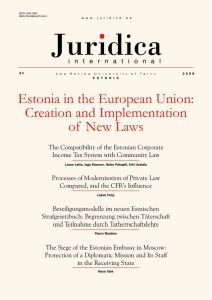
		<description><![CDATA[Estonia in the European Union: Creation and Implementation of New Laws]]></description>
		<language>en</language>
		
																																																																																				
		<lastBuildDate>Wed, 01 Apr 2009 23:20:30 +0300</lastBuildDate>
		
									
				<item>
			<title><![CDATA[cover]]></title>
			
			<link>http://www.juridicainternational.eu/index.php?id=14816</link>
			
			<description><![CDATA[<p><a href="http://www.juridicainternational.eu/public/covers/ji_2008_2_cover.jpg" rel="lightbox">
<img vspace="0" hspace="0" border="0" alt="" src="http://www.juridicainternational.eu/public/covers/ji_2008_2_cover_tn.jpg" />
</a>
</p>]]></description>						<guid>http://www.juridicainternational.eu/?id=14816</guid> 
			<pubDate>Mon, 19 Sep 2011 00:00:00 +0300</pubDate>
		</item>
						
				<item>
			<title><![CDATA[The Draft Common Frame of Reference’s Regulation of Unjustified Enrichment: Some Observations from Estonia’s viewpoint]]></title>
			
			<link>http://www.juridicainternational.eu/index.php?id=12749</link>
			
			<description><![CDATA[<h2>1. Introduction</h2> <p align="justify">Questions regarding the harmonisation of private law have evoked several debates in the European Union in the last few decades. These have expanded and become livelier especially in connection with the European Civil Code project.<sup>*1</sup> The process of harmonisation of European private law also affects Estonia, even in areas not regulated by European Union legislation mandatory for the Member States. Thus, for example, the Principles of European Contract Law<sup>*2</sup> (PECL) and the UNIDROIT Principles of International Commercial Contracts<sup>*3</sup> (PICC) played a special role in the drafting of the Estonian Law of Obligations Act<sup>*4</sup> (LOA). </p> <p align="justify">On 28 December 2007, the European Commission was presented with the Draft Common Frame of Reference<sup>*5</sup> (DCFR), which comprises the principles, definitions, and model rules of European private law. As the general provisions of the law of obligations in the Draft Common Frame of Reference are based on the PECL<sup>*6</sup> , it is likely that the need to supplement or amend existing Estonian legislation in light of the general principles set out in the DCFR may more particularly concern the specific provisions of the Law of Obligations Act, among them the provisions pertaining to non-contractual obligations<sup>*7</sup> , including unjustified enrichment law. With regard to the DCFR, the following functions are given primary emphasis: 1) a model for a political Common Frame of Reference, envisaged by the European Commission in its Communication document of 2003<sup>*8</sup> ; 2) an academic text as a model for teaching and research work, aiding in understanding of the similarities of the private law in the jurisdiction of the European union; and 3) a source of inspiration for the legislators of countries in the process of modernising national law.<sup>*9</sup> </p> <p align="justify">This article examines the third of the above-mentioned functions and discusses the regulation of unjustified enrichment within the DCFR in comparison with the existing Estonian legislation. The objective of this article is to answer the question of whether and to what extent the DCFR could serve as an inspiration for the amendment, supplementation, or interpretation of Estonian unjustified enrichment law. On account of limitations of space, the article focuses on only some aspects of DCFR unjustified enrichment model rules, among them the prerequisites for claims for the transfer of that which is received without legal basis, the method for reversing enrichment, and the calculation of compensation, and it compares the solutions provided to those of existing Estonian legislation. The article also discusses certain questions regarding delimitation of the rules of unjustified enrichment and <i>negotiorum gestio</i>. </p> <a href="/index.php?id=12749">More...</a>]]></description>						<guid>http://www.juridicainternational.eu/?id=12749</guid> 
			<pubDate>Wed, 01 Apr 2009 00:00:00 +0300</pubDate>
		</item>
						
				<item>
			<title><![CDATA[The Buyer’s Free Choice Between Termination and Avoidance of a Sales Contract]]></title>
			
			<link>http://www.juridicainternational.eu/index.php?id=12748</link>
			
			<description><![CDATA[<h2>1. Introduction</h2> <p align="justify">National private law systems of European Union member states have different approaches with respect to freely allowing or restricting the concurrence of avoidance for mistake and termination of contract. For instance in Germany<sup>*1</sup> , upon sale of a defective thing, the priority of applying a contractual legal remedy applies, and termination is either excluded or significantly restricted, even though a case of mistake <i>per se </i>would actually exist. The Austrian and Swiss civil codes, however, allow free concurrence of such claims; in Spain and Italy, juridical practice has recognised the right of one party — the buyer — to choose the most suitable remedy.<sup>*2</sup> There are no provisions in the Estonian Law of Obligations Act<sup>*3</sup> (LOA) or the General Part of the Civil Code Act<sup>*4</sup> (GPCCA) that would prevent the entitled party from using the most suitable remedy if both termination and avoidance are simultaneously available. Conflicting viewpoints have, however, been expressed on this matter in Estonian legal discourse.<sup>*5</sup> </p> <p align="justify">Differing positions with respect to this question have also been assumed in the uniform law instruments (UNIDROIT Principles of International Commercial Contracts<sup>*6</sup> (PICC), Draft Common Frame of Reference<sup>*7</sup> (DCFR), and Vienna Convention on Contracts for the International Sale of Goods<sup>*8</sup> (CISG)). Pursuant to Article 3.7 of the PICC, for instance, a party is not entitled to avoid a contract on grounds of mistake if the circumstances on which that party relies afford, or could have afforded, a remedy for non-performance; i.e., the primacy of a contractual remedy applies. Pursuant to DCFR II.–7:216, however, a person is entitled to freely choose the most suitable remedy. With regard to the CISG, European Union member states have applied different interpretations regarding the relations and primacy of the right of termination of contract in relation to the right of avoidance of a contract governed by national law.<sup>*9</sup> The above suggests that the prerequisites for and consequences of termination and avoidance of contracts require a comparative approach and clarification, as do situations of fact wherein the compositions of both termination and avoidance may be simultaneously fulfilled. </p> <a href="/index.php?id=12748">More...</a>]]></description>						<guid>http://www.juridicainternational.eu/?id=12748</guid> 
			<pubDate>Wed, 01 Apr 2009 00:00:00 +0300</pubDate>
		</item>
						
				<item>
			<title><![CDATA[The Impact of European Union Law on Employee Involvement in Estonia]]></title>
			
			<link>http://www.juridicainternational.eu/index.php?id=12747</link>
			
			<description><![CDATA[<h2>1. Introduction</h2> <p align="justify">Estonia started to co-ordinate its labour legislation with European Union (EU) law after entering into the Association Agreement<sup>*1</sup> with the European Communities and their Member States in 1995, insofar as with that agreement Estonia undertook to converge and harmonise Estonian legislation with European Union law, especially in the fields of commerce, economy, and related areas, including with respect to matters pertaining to employee protection (addressed in Articles 68 and 69 of the Association Agreement). According to the European Commission White Paper of 1994, the associated Member States had to implement the necessary accession measures in order to transpose into national law and practice the basic rules of Community social policy, including the seven labour rights directives established by that time.<sup>*2</sup> Of this legislation, employee involvement was discussed in Directive 94/45/EEC<sup>*3</sup> , on the establishment of a European Works Council, and the obligation to inform and consult employees was also included in Directive 75/129/EEC<sup>*4</sup> , on collective redundancies, and in Directive 77/187/EEC<sup>*5</sup> , on transfers of undertakings. </p> <p align="justify">The labour legislation that existed in Estonia before accession to the EU included no fundamental disagreement with EU law; in some areas that the EU had considered necessary to regulate, however, rules had not been established or were insufficient in their detail.<sup>*6</sup> Three areas can be pointed out in which the harmonisation of Estonian legislation with European law turned out to be most problematic. These are the equal treatment of employees, the limitation of weekly maximum working time, and employee involvement.<sup>*7</sup> While with respect to harmonising the regulation of the amount of working time the most immediate necessity was to change practical organisation of work in order to decrease working time from 60 hours to 48 hours a week<sup>*8</sup> , with respect to equal treatment of employees and employee involvement the differences existed more in principle. Estonian national law included individual provisions addressing both areas, but in practice their meaning was marginal. While, with regard to equal treatment of employees, the reason behind the minimal regulation could have been the society’s meagre knowledge of equal treatment and equal opportunities<sup>*9</sup> , the absence of employee involvement regulation was mostly due to the low importance of employee trustees in shaping employment relationships.<sup>*10</sup> </p> <a href="/index.php?id=12747">More...</a>]]></description>						<guid>http://www.juridicainternational.eu/?id=12747</guid> 
			<pubDate>Wed, 01 Apr 2009 00:00:00 +0300</pubDate>
		</item>
						
				<item>
			<title><![CDATA[Processes of Modernisation of Private Law Compared, and the CFR’s Influence]]></title>
			
			<link>http://www.juridicainternational.eu/index.php?id=12745</link>
			
			<description><![CDATA[<h2>1. Introduction</h2> <p align="justify">The purpose of this article is to explain what constitutes the approach of the Czech legislator in recodifying Czech private law, and to justify my position that this is the optimal way forward. I will reach this aim through having completed a relatively extensive and broad-ranging analysis. </p> <p align="justify">Having established a starting point, in the second part of the paper I point out the various possibilities of the method and address, in particular, its place in view of the background of private law in the ‘new’ member states of the EU, which have a recent history similar to that of the Czech Republic behind them — i.e., the influence of the Soviet model. In this part of the paper, I will attempt to show how differences, and frequently also rational influences, played their part in the further development of the private law system. </p> <p align="justify">Following this, in the third section, I evaluate the significance of the Draft Common Frame of Reference (DCFR) and other national or supranational codification or similar projects. Furthermore, I continue the discussion concentrating on the Czech Republic and provide an analysis of the decisive factors related primarily to the content and method of legislation in the country’s new civil code. Finally, I offer justification for the adoption of the DCFR as a model in many areas of private law for the re-codification thereof. </p> <a href="/index.php?id=12745">More...</a>]]></description>						<guid>http://www.juridicainternational.eu/?id=12745</guid> 
			<pubDate>Wed, 01 Apr 2009 00:00:00 +0300</pubDate>
		</item>
						
				<item>
			<title><![CDATA[Specificatio in Baltic Private Law and Production (Verarbeitung) in the Baltic Private Law Act - Continuity or Change?]]></title>
			
			<link>http://www.juridicainternational.eu/index.php?id=12744</link>
			
			<description><![CDATA[<p align="justify">In the second half of the 19<sup>th</sup> century, the private law of the Baltic Sea provinces<sup>*1</sup> , which were a part of the Russian Empire, took an important turn — in 1864, the codification of Baltic private law<sup>*2</sup> entered into force in the Baltic Private Law Act (BES). Until then, different laws applied for the Baltic Sea provinces, which included in addition to medieval bylaws also chivalric and regional laws and the norms of Swedish, Russian, and Polish laws, with subsidiary application of Roman laws, and which generally can be called Baltic provincial law. Roman Law was recepted into the system to a greater extent from the 13<sup>th</sup> century. In 18<sup>th</sup> –19<sup>th</sup> -century court practice, Roman Law was allegedly preferred to the local law even if local laws should have been applied as primary sources; a contemporarywork<sup>*3</sup> states (in translation): “Roman Law — to that extent it is glossed — is recepted in its entirety in Germany and also in Livonia and Estonia and is used everywhere where the norms of Roman Law did not derive from the special Roman government or where the principles of Roman Law are not in direct opposition to the principles of the provincial law”.<sup>*4</sup> </p> <p align="justify">Unlike the laws adopted in Western Europe in the 19<sup>th</sup> century generally, the purpose of the BES was not to create a new, modern private law by means of a legislative reform. On the contrary, the general ideology of the Russian Empire’s codification movement and the intention of Friedrich Georg von Bunge<sup>*5</sup> was to compile<sup>*6</sup> existing private law and create <i>nova structura veterum legum</i>.<sup>*7</sup> Bunge claimed in his programmatic essay on the scientific treatment of Baltic private law and its handling in codification that, in drafting of the future law, the principles of Roman Law should be avoided as much as possible.<sup>*8</sup> At the same time, he admitted that Roman Law is a common element of all provincial laws and excluding Roman Law from provincial law would mean an incomplete treatment of the local private law. This treatment of local laws had to be “trustworthy and complete”.<sup>*9</sup> Therefore, the future code had to be a complete compilation of all laws that were to be in force in the various provinces, including Roman Law, where it was in force in a subsidiary role as <i>ius commune</i>. </p> <a href="/index.php?id=12744">More...</a>]]></description>						<guid>http://www.juridicainternational.eu/?id=12744</guid> 
			<pubDate>Wed, 01 Apr 2009 00:00:00 +0300</pubDate>
		</item>
						
				<item>
			<title><![CDATA[The Council of the University of Tartu awarded at its 30 May 2008 session Professor Emeritus Werner Krawietz from the University of Münster the title of honorary doctor]]></title>
			
			<link>http://www.juridicainternational.eu/index.php?id=12743</link>
			
			<description><![CDATA[<p align="justify">Werner Krawietz was born in 1933 in Beuthen. From 1954 to 1960, he studied law, economics, philosophy, and sociology at the universities of Freiburg, Graz, and Münster. In 1960, he defended his doctoral thesis in economic and social sciences at the University of Graz and in 1965 his doctoral dissertation in law at the University of Münster. Also at the University of Münster he defended his <i>habilitation</i> degree work in 1974; he then worked there until 1979 with the title of Professor of Public Law, General Theory of Law, and Legal Philosophy. In 1979, he became the head of the Chair of the Sociology of Law and Legal and Social Philosophy. Then, in 1981−1982, he was the dean of the Faculty of Law of the University of Münster. From 1982 on, he was also a professor at the Central Institute of Spatial Planning at the University of Münster. Moreover, in 1982 he became a professor at the European Faculty of Sciences of Land Strasbourg. In 1990, the University of Helsinki awarded him an honorary doctorate. Later, in 1997, he became an honorary doctor also at the Russian Academy of Sciences. For many years, Krawietz has been deputy head of the German section of the International Society for Philosophy of Law and Social Philosophy. In 1974, he founded the journal <i>Rechtstheorie. Zeitschrift für Logik, Methodenlehre, Kybernetik und Soziologie des Rechts</i>, and since then he has been its publisher as well. After his retirement from professor’s work in 1998, he continued his academic organisational activities and became director of the International Centre of German−Russian Legal Studies at the University of Münster. In addition, since 2002 he has been a member of the co-ordination committee of the German−Russian University Centre for Legal Studies Moscow. </p> <p align="justify">Krawietz has been a highly productive scholar. The <i>Festschrift</i> volume <i>Theorie des Rechts und der Gesellschaft</i>, published in honour of his 70<sup>th</sup> birthday, contains a bibliographical annex that lists 357 publications. These include 42 monographs or parts thereof. His scholarly interest has been very broad, including questions of public law — in particular, constitutional law, the general part of administrative law, legal methods, theory of law and state, sociology of law (informational and communication theory as well as system and institution theory), and legal and social philosophy (especially philosophy of language, logic, and norm ontology and the field of behavioral and value theory). </p> <p align="justify">The contact between Krawietz and the Faculty of Law of the University of Tartu was established in 1992, soon after Estonia regained its independence. He has visited Tartu many times and presented lectures to our students. He has helped to arrange two international conferences based on which special issues of the academic journal <i>Rechtstheorie</i> have been or will be published (entitled ‘Rechtspolitik und Gesetzgebung’ and ‘Multiple Modernität, Globalisierung der Rechtsordnung und Kommunikatsionsstruktur der Rechtssysteme’, respectively). In both cases, the main authors are legal scholars at the University of Tartu. All of this shows that Krawietz has played an outstanding role in giving Estonian legal thought access in global academic fora. Additionally, Krawietz has been a foreign member of the editorial board of <i>Juridica International</i>, the law review of the University of Tartu, since the inception of the journal, securing with his participation high academic standards for the publication. He also strongly supported the application of the Estonian Society for Philosophy of Law and Social Philosophy to become a member of the International Society for Philosophy of Law and Social Philosophy (IVR). The application was approved at the world congress of the IVR in New York in 1997. </p> <p align="justify">Taking into account the outstanding scholarly achievements of Professor Werner Krawietz and his contributions to making Estonian legal scholarship more visible in Europe and at a global level, the University of Tartu is very pleased to award him the title of honorary doctor. </p> <a href="/index.php?id=12743">More...</a>]]></description>						<guid>http://www.juridicainternational.eu/?id=12743</guid> 
			<pubDate>Wed, 01 Apr 2009 00:00:00 +0300</pubDate>
		</item>
						
				<item>
			<title><![CDATA[Terminological Turn As a Turn of Legal Culture]]></title>
			
			<link>http://www.juridicainternational.eu/index.php?id=12742</link>
			
			<description><![CDATA[<h2>1. Introduction </h2> <p align="justify">This article deals with the turning points in Estonian legal terminology in the transition from the Soviet era to the integration into Europe, considering the usage of Latin terms in juridical journals. Employing Latin terms is characteristic of European legal cultures and legal writings. The development of law in continental Europe has relied heavily on the Latin language and the system of concepts based on Roman law; historically, Latin has been extremely closely connected with the development of European law. In previous centuries, the bulk of legal literature and much legislation was compiled in Latin. Although Latin ceased to be the language of law and legal science in the 20<sup>th</sup> century, its significance as a technical means of communication among lawyers in Europe remains. The conciseness and linguistic economy of Latin terms encourages their use.<sup> *1</sup> Precisely formulated Latin terms facilitate international communication of lawyers and enable them to exchange information and ideas effectively despite linguistic and cultural boundaries.<sup> *2</sup> </p> <p align="justify">Juridical journals have been chosen as the material for this research because periodicals are formally the most dynamic medium of law. According to M. Stolleis, in essence they could be called the ‘medial crossing-point’ where legal science, judicial and administrative practice, legal politics, and general politics meet.<sup> *3</sup> Legal periodicals are a mirror of the legal culture. </p> <p align="justify">It is obvious that different legal cultures shape very different journalism. Three major turning points and rearrangements in Estonian legal history in the course of the 20<sup>th</sup> century have had a strong impact on the legal culture and changed it considerably: 1918 with the creation of the Republic of Estonia, 1940 and 1944’s Soviet occupation, and the regaining of independence in 1991. At all of these points, radical legal reforms occurred. </p> <a href="/index.php?id=12742">More...</a>]]></description>						<guid>http://www.juridicainternational.eu/?id=12742</guid> 
			<pubDate>Wed, 01 Apr 2009 00:00:00 +0300</pubDate>
		</item>
						
				<item>
			<title><![CDATA[On Imperative Regulation of Information Duties in Financial Services Contracts]]></title>
			
			<link>http://www.juridicainternational.eu/index.php?id=12750</link>
			
			<description><![CDATA[<p align="justify">The principle of freedom of contract is the main principle of harmonised European contract law.<sup>*1</sup> Although a contract creates only relative legal relations (i.e., legal relations between the parties to the contract), it may also concern interests requiring protection of the interests of third persons. The freedom of contract should be restricted where the background of its impact is not compatible with the regime of individual rights.<sup>*2</sup> Modernisation processes — first and foremost, the evolution of the ‘cyber’ world — and, at the same time, dramatic change in the security situation of society in the wake of 11 September 2001 and the acts of terror that followed, and the crisis of the financial markets that began in 2007, have forced Europe to cherish more the security of society and sustainable development of the economy.<sup>*3</sup> At a time of formation of a ‘risk society’, one cannot but support the position of Professor M. R. Marella that the general principle of human dignity set forth in Article 1 of the Charter of Fundamental Rights of the European Union should be seen as a potential source for new restrictions of the freedom of contract under European law.<sup>*4</sup> National, supranational, and international imperative legislative or regulatory provisions of public law may affect the validity of a contract — a principle taken into account in Article 15:102 of the Principles of European Contract Law<sup>*5</sup> (PECL). Article 15:101 of the PECL provides that a contract is of no effect to the extent that it is contrary to principles recognised as fundamental in the laws of the Member States of the European Union. Essentially the same idea is expressed as a key value in the Draft Common Frame of Reference (DCFR), prepared by the Study Group on a European Civil Code and the Acquis Group, which was presented to the Commission of the European Communities on 28 December 2007.<sup>*6</sup> </p> <a href="/index.php?id=12750">More...</a>]]></description>						<guid>http://www.juridicainternational.eu/?id=12750</guid> 
			<pubDate>Wed, 01 Apr 2009 00:00:00 +0300</pubDate>
		</item>
						
				<item>
			<title><![CDATA[Subordination of Shareholder Loans in Estonian Law]]></title>
			
			<link>http://www.juridicainternational.eu/index.php?id=12751</link>
			
			<description><![CDATA[<h2>1. Introduction</h2> <p align="justify">One basis of a Continental European company are the capital rules whose purpose is the protection of creditors of companies and which prohibit the repayment of contributions to shareholders during the lifetime of a company. The concept of capital rests on the assumption that a company’s assets are constituted by means of share capital, on account of which the creditors can satisfy claims submitted by them against the company.<sup>*2</sup> Whether this objective can be achieved by means of capital rules is a different matter. It is clear that all business activities require a certain amount of capital. At the same time, the corresponding limits have not been established in Continental European law; the amount of obligatory investment has instead been determined by minimum capital requirements. In legislation, these requirements are established as universal for all companies and the company’s actual capital needs are not taken into account.<sup>*3</sup> If shareholders invest in a company in such a way that the share capital is constituted in a minimum amount prescribed by legislation and the rest of the capital needed for the company’s activity is lent to the company, they have fulfilled their obligation to form share capital of a certain amount, but it is clear that the equity capital investment they made is not sufficient. In this way they do, however, create the possibility to take the investment from the company without having to undergo complicated procedures. It must also be taken into account that several Continental European countries either have already removed the minimum capital requirement from their legislation or plan to do this in the near future, which means that any formal equity capital investment requirement will cease to exist in these companies. In these conditions, the likelihood will further increase that all capital necessary will be given to the company as a loan. </p> <p align="justify">It may also be inevitable that shareholders give loans to companies, because if a company is facing financial problems and needs additional capital to continue its activity, it is often in a situation in which acquiring additional capital from third parties (including banks) is impossible as all securable assets are already encumbered or third parties do not want to take excessive risks. In addition, capital from shareholders may be less expensive. In this case, there are also two possibilities: to make an equity capital investment (particularly by means of increasing share capital) and to give the company a loan. </p> <a href="/index.php?id=12751">More...</a>]]></description>						<guid>http://www.juridicainternational.eu/?id=12751</guid> 
			<pubDate>Wed, 01 Apr 2009 00:00:00 +0300</pubDate>
		</item>
			
	</channel>
</rss>