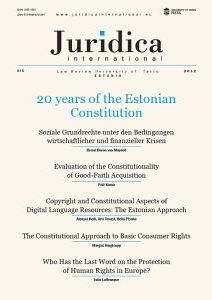

<?xml version="1.0" encoding="UTF-8"?>
<rss version="2.0">


	<channel>
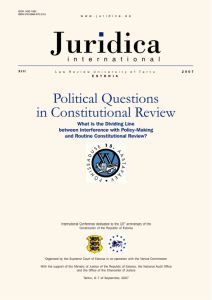
		<title><![CDATA[Juridica International: Vol. XIII ]]></title>
		<link>http://www.juridicainternational.eu/index.php?id=10551</link>
		<description><![CDATA[Political Questions in Constitutional Review
What is the Dividing Line between Interference with Policy-Making and Routine Constitutional Review?]]></description>
		<language>en</language>
		
																																																																																				
		<lastBuildDate>Wed, 01 Apr 2009 23:20:28 +0300</lastBuildDate>
		
									
				<item>
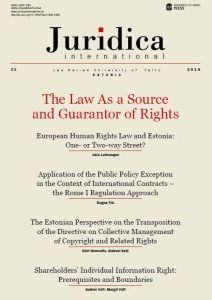
			<title><![CDATA[cover]]></title>
			
			<link>http://www.juridicainternational.eu/index.php?id=14814</link>
			
			<description><![CDATA[<p><a href="http://www.juridicainternational.eu/public/covers/ji_2007_2_cover.jpg" rel="lightbox">
<img vspace="0" hspace="0" border="0" alt="" src="http://www.juridicainternational.eu/public/covers/ji_2007_2_cover_tn.jpg" />
</a>
</p>]]></description>						<guid>http://www.juridicainternational.eu/?id=14814</guid> 
			<pubDate>Mon, 19 Sep 2011 00:00:00 +0300</pubDate>
		</item>
						
				<item>
			<title><![CDATA[A Comparative Presentation on Constitutional Courts as Guardians of Competition between Political Parties]]></title>
			
			<link>http://www.juridicainternational.eu/index.php?id=12706</link>
			
			<description><![CDATA[<h2>1. Democracy means competition</h2> <p align="justify">1.1. Democracy as an arrangement of competition </p> <p align="justify">One major feature of any form of democracy is that there is some form of competition among candidates and/or parties to come into positions that are vested with the power to make binding decisions. Behind this struggle for decision-making positions, of course, there is a competition among different interests and ideas. <sup>*1</sup> This means that democratic competition is only on its surface a competition among persons and organisations. Underlying that competition and fuelling it are strong antagonisms between rival conceptions as to how society <b>should</b> be. </p> <p align="justify">The use of this concept of democracy does not mean that democracy should be defined only via this competition-based approach, as Joseph A. Schumpeter does. <sup>*2</sup> Democracy means more than just an electoral method; it has to do with certain degrees of freedom, with the emphatic idea of individual and collective autonomy and self-determination. In any case, competition is an indispensable element of any modern form of democracy. <sup>*3</sup> </p> <a href="/index.php?id=12706">More...</a>]]></description>						<guid>http://www.juridicainternational.eu/?id=12706</guid> 
			<pubDate>Wed, 01 Apr 2009 00:00:00 +0300</pubDate>
		</item>
						
				<item>
			<title><![CDATA[How to Handle a Double-edged Sword Safely: Protection of the Elements of the Principle of the Social State in the Constitutional Jurisprudence of the Supreme Court of Estonia]]></title>
			
			<link>http://www.juridicainternational.eu/index.php?id=12704</link>
			
			<description><![CDATA[<p align="justify">Most traditionally, it has been held that guaranteeing a modicum of social protection to those in need would be the exclusive task of the legislator within the political process. <sup>*1</sup> According to this approach, social entitlements were deemed not to belong to a constitution <sup>*2</sup> ; and even if some social rights did, in fact, appear in a constitutional text, they would have been considered mere directive principles. <sup>*3</sup> </p> <p align="justify">In contemporary constitutional democracies, however, the tide has turned. Social rights are taken increasingly seriously as legal rights capable of being invoked before domestic <sup>*4</sup> or international courts. <sup>*5</sup> </p> <p align="justify">Once social-rights-related claims have entered the realm of judicial decision-making, the courts concerned must make up their minds as to how to handle such claims safely, as implementation of social rights routinely gives rise to a number of complex issues that may lead to questioning the legitimacy of judicial intervention or demonstrate the incompetence of the courts. The most cautious courts could combine various judicial techniques in order to achieve a balance between their obligation to protect fundamental rights of individuals and that of reasonably preserving the balance of powers. </p> <a href="/index.php?id=12704">More...</a>]]></description>						<guid>http://www.juridicainternational.eu/?id=12704</guid> 
			<pubDate>Wed, 01 Apr 2009 00:00:00 +0300</pubDate>
		</item>
						
				<item>
			<title><![CDATA[The Role of the Constitutional Court in Democratic Society]]></title>
			
			<link>http://www.juridicainternational.eu/index.php?id=12703</link>
			
			<description><![CDATA[<p align="justify">The constitutional court is a central but not the only instrument of democracy and constitutionalism. There cannot be a constitutional court without a constitution. Therefore, the role of the constitutional court should be viewed in a wider perspective embracing the general issues of democracy, constitution, and constitutionalism. </p> <p align="justify">There is reason to believe that, relying on our earlier experience of statehood and having lived according to our constitution and practising democracy for the past 15 years, while being in close co-operation with democratic states in Europe and elsewhere in the world, we have learned something. We have passed the beginner course in constitutional democracy. </p> <p align="justify">This allows me to limit the ‘general part’, as lawyers would say, and address some issues of Estonian constitutionalism that concern us today. My article broadly consists of two parts: the first considers the role of the constitution and constitutional court in democratic society, and the second part (the ‘implementation’ part) briefly assesses Estonia ’s current situation of constitutional law and asks how we should proceed. </p> <a href="/index.php?id=12703">More...</a>]]></description>						<guid>http://www.juridicainternational.eu/?id=12703</guid> 
			<pubDate>Wed, 01 Apr 2009 00:00:00 +0300</pubDate>
		</item>
						
				<item>
			<title><![CDATA[Constitutional Courts in Central and Eastern Europe: What Makes a Question Too Political?]]></title>
			
			<link>http://www.juridicainternational.eu/index.php?id=12702</link>
			
			<description><![CDATA[<p align="justify">When constitutional courts and political questions are mentioned in the same sentence in post-Communist Central and Eastern Europe , several rather discomforting scenarios come to mind even when only news items of the past year or so are scanned. </p> <p align="justify">One will find, for instance, that the Romanian Constitutional Court was deeply involved with the impeachment of the country’s president in the spring of 2007. <sup>*1</sup> After a scandal erupted around him in early January 2007, the Constitutional Court first reviewed an amendment to the referendum law that would have made it easier to impeach the President (20 February 2007); then it found that it was constitutional to set up a parliamentary investigation commission inquiring into the President’s activities (21 March 2007). These decisions were followed by the court finding that, although the President’s alleged acts were seriously problematic, they were not severe enough to merit impeachment (5 April 2007) — a point made while the impeachment procedure was still pending in Parliament. The Constitutional Court then sent an explanation of this decision to the parliament in a matter of days ( 17 April 2007 ). Once Parliament voted in favour of suspending President Băsescu, the Constitutional Court confirmed the interim president without further ado (20 April 2007). President Băsescu refused to resign <sup>*2</sup> , and in a month voters refused to impeach him in a referendum. <sup>*3</sup> </p> <a href="/index.php?id=12702">More...</a>]]></description>						<guid>http://www.juridicainternational.eu/?id=12702</guid> 
			<pubDate>Wed, 01 Apr 2009 00:00:00 +0300</pubDate>
		</item>
						
				<item>
			<title><![CDATA[Discrimination Law and Social Rights: Intersections and Possibilities]]></title>
			
			<link>http://www.juridicainternational.eu/index.php?id=12701</link>
			
			<description><![CDATA[<h2>1. Introduction</h2> <p align="justify">In both academic articles and court judgments, a connection is frequently drawn between the idea of substantive equality, developed in the sphere of discrimination law, and social rights. To give just one example, in Grootboom, the South African Constitutional Court ’s leading judgment on social rights, the court observed that the case brought home “the harsh reality that the Constitution’s promise of dignity and equality for all remains a distant dream”. <sup>*1</sup> Generally, however, such statements are left undeveloped. Part of the aim of this article is to explore the connection between social rights and equality, so often drawn but so seldom elaborated. A further aim is to consider the limits of judicial activism in this area. How far can courts go in enforcing social rights, given the clear policy questions that these rights would seem to raise? </p> <p align="justify">This article discusses these issues in light of the social rights jurisprudence of the South African Constitutional Court . The first part introduces the concepts of social rights and substantive equality. In brief, it argues that the substantive approach to discrimination law is distinctive insofar as it allows for preference to be accorded to worse-off groups, thereby accommodating the promotion of equality within the sphere of discrimination law. Thereafter, the article discusses the most obvious connection between discrimination law and social rights — that is, where a social programme distinguishes between people on the basis of a ground of discrimination. This discussion is undertaken in light of the Constitutional Court ’s judgment in Khosa. <sup>*2</sup> </p> <a href="/index.php?id=12701">More...</a>]]></description>						<guid>http://www.juridicainternational.eu/?id=12701</guid> 
			<pubDate>Wed, 01 Apr 2009 00:00:00 +0300</pubDate>
		</item>
						
				<item>
			<title><![CDATA[Rights, Democracy and Local Self-governance: Social Rights in the Constitution of Finland]]></title>
			
			<link>http://www.juridicainternational.eu/index.php?id=12700</link>
			
			<description><![CDATA[<h2>1. The argument from democracy</h2> <p align="justify">Economic, social, and cultural rights, enshrined in a state’s constitution, pose difficult problems as to their legal significance and their compatibility with such basic principles of the constitutional state — the democratic <i>Rechtsstaat</i> — as democracy, the separation of powers, and local self-governance. These rights, often termed second-generation constitutional rights, can easily be interpreted as symptoms of an excessive constitutionalisation of the legal order and of a development toward the so-called judicial state. Such a development involves&nbsp;— in a rather paradoxical way — the risk of both a politicisation of adjudication and a juridification of politics: a politicisation of adjudication in the sense that courts take a position on issues of a political nature that should be left to the domain of political decision-making in the Parliament and the government and a juridification of politics in the sense that legislative activities are increasingly seen as a specification and implementation of decisions already made at the constitutional level. If the municipalities are entrusted with the organisation of, for instance, social and health services — as is the case in the Nordic countries — the problems raised by the second-generation basic rights also touch on the relationship between the judiciary and local self-government. I shall try to analyse these general problems through the example provided by the Finnish Constitution. However, I shall start with a brief discussion at the level of constitutional theory and philosophy. </p> <a href="/index.php?id=12700">More...</a>]]></description>						<guid>http://www.juridicainternational.eu/?id=12700</guid> 
			<pubDate>Wed, 01 Apr 2009 00:00:00 +0300</pubDate>
		</item>
						
				<item>
			<title><![CDATA[Judicial Activism in Constitutional Review Decisions of the Supreme Court of Estonia]]></title>
			
			<link>http://www.juridicainternational.eu/index.php?id=12699</link>
			
			<description><![CDATA[<p align="justify">The choice of the subject of the international conference organised by the Supreme Court of the Republic of Estonia and dedicated to the 15<sup>th</sup> anniversary of the Constitution of the Republic of Estonia — Political Questions in Constitutional Review: What is the Dividing Line between Interference in Policy-Making and Routine Constitutional Review? — implies that the highest court in Estonia seems to feel somewhat uncomfortable about its task of constitutional review. <sup>*2</sup> The Estonian Supreme Court is by no means exceptional in this regard. All over the world, constitutional courts or their counterparts entrusted with the review of the constitutionality of the decisions adopted by a democratically legitimised legislator must test the bases and the limits of their existence from time to time. </p> <p align="justify">In the course of such fight for the right of existence of constitutional courts (and sometimes against it), a number of scientific works have been born. These can be broadly divided into three categories. Some researchers are dedicated, in line with their understanding of the substance and limits of the modern concept of the separation of powers, to advocating or criticising the interference of the constitutional courts in policy-making. A second school attempts to rank the constitutional courts of the world by the degree of their interference in policy-making. The third, predominantly social science approach, declares the search for the proper boundaries of the power of the courts and the relevant classification utterly useless. <sup>*3</sup> Regardless of the approach taken, the discussion upon the appropriate limits of constitutional adjudication employs the notion of judicial activism, which has become one of the key concepts of modern constitutional law. <sup>*4</sup> This article enters the discussion mentioned above, trying to answer the question about the degree of activism of the constitutional court closest to the author — the Supreme Court of Estonia (hereinafter the Supreme Court). </p> <a href="/index.php?id=12699">More...</a>]]></description>						<guid>http://www.juridicainternational.eu/?id=12699</guid> 
			<pubDate>Wed, 01 Apr 2009 00:00:00 +0300</pubDate>
		</item>
						
				<item>
			<title><![CDATA[Judicial Activism in the Practice of the German Federal Constitutional Court: Is the GFCC an Activist Court?]]></title>
			
			<link>http://www.juridicainternational.eu/index.php?id=12698</link>
			
			<description><![CDATA[<p align="justify">The question of whether the Federal Constitutional Court is an activist court cannot simply be answered ‘yes’ or ‘no’. In Germany, lawyers have a standard answer to questions that cannot be answered with a mere ‘yes’ or ‘no’. That answer is: ‘It depends.’ This is also the first way in which I would like to reply to the key question I will address here. Of course, however, I will as the discussion progresses try to answer it in a differentiated manner and to substantiate my answer by making reference to some selected examples from the Federal Constitutional Court ’s case law. In this context, one must differentiate matters according to the reasons for the Federal Constitutional Court ’s scope for formative action, which means that one must differentiate among the following aspects: </p> <p align="justify">1. the Federal Constitutional Court ’s competencies; </p> <p align="justify">2. the content of the Federal Constitutional Court ’s decisions; and </p> <p align="justify">3. the effect of the Federal Constitutional Court ’s decisions. </p> <a href="/index.php?id=12698">More...</a>]]></description>						<guid>http://www.juridicainternational.eu/?id=12698</guid> 
			<pubDate>Wed, 01 Apr 2009 00:00:00 +0300</pubDate>
		</item>
						
				<item>
			<title><![CDATA[Opening speech at the International Research Conference on the 15th Anniversary of the Constitution]]></title>
			
			<link>http://www.juridicainternational.eu/index.php?id=12687</link>
			
			<description><![CDATA[<p align=justify>Having re-established independence, Estonia is celebrating the 15<sup>th</sup> anniversary of the national constitution. The conference about to begin is one of the weightiest on the list of anniversary events and certainly the most law-oriented in its content. </p> <p align=justify>The Constitution of Estonia, which was passed by referendum on 28 June 1992 , is&nbsp;the fourth fundamental document of our statehood, which will soon celebrate its 90<sup>th</sup> jubilee, while it is the first Constitution that has laid the basis for protection of human rights and the development of democracy and the rule of law. I dare say that our Constitution is a modern set of legal values and principles that has a clear regulatory impact on regulations and is therefore different from those many constitutions that constitute sets of eloquent declarations or political programme documents. </p> <p align=justify>The Constitution is alive and working. The Constitution is respected. While certain indications of nihilism are apparent in the public discussion of the implementation of some other legal acts, then non-compliance with the requirements of the Constitution has not been accepted by the public. Rather, abidance by the Constitution and constitutional thought are used as arguments to criticise misconduct, meaning that the Constitution has a position of authority in public thought. </p> <p align=justify>Fifteen years of validity have proved that all of our disputes of public affairs and society can be settled on the basis of the provisions of the Constitution. As a universal legal act, the Constitution has not allowed any serious constitutional crises to&nbsp;occur in Estonia , although the press has sometimes made ominous predictions. </p> <p align=justify>The Constitution represents a national agreement made 15 years ago to strengthen and develop our state in unfaltering faith and unwavering will. This agreement is timeless, for the state and the law, being in constant change, cannot rely in their development only on a national agreement or national interest. Indispensably, this small nation had to choose the cultural area to which to belong, who to resemble, and whom to contrast against. The Constitution reflects this choice. The Constitution functions as the fundamental act of the legal order. A modern legal system has been built up relying on the Constitution, which is based on European legal values and principles and harmonises with the European legal area. </p> <p align=justify>When speaking about the importance and strengths of the Constitution, we cannot overlook the constant discussion concerning whether Estonia needs a new constitution. Let us admit that the 15-year-old Constitution has passed the test of time. The Constitution is nowhere near flawless as a legal act, but what constitution is? The Constitution is, in the first place, a compromise between the political forces active at the time of its adoption, or, if you will, a public agreement made at the time of the greatest awakening of the nation, and only in the second place is it a legislative act. It is worth mentioning that those amendments that have been made to the Constitution over the past 15 years have not changed the nature, spirit, or idea of the Constitution. In its current form, the Constitution may be said to have guided the development of Estonia ’s statehood for the longest time when compared to our earlier constitutions, and it has in this time proved that an unchanged constitution is&nbsp;a serious constitutional value. </p> <p align=justify>The Constitution Amendment Act, which was passed by referendum on 13 September 2003 for accession to the European Union, did not change the grammatical structure of the provisions or the underlying fundamental values of the Constitution. The amendment act changed the entire legal attitude to the Constitution itself. </p> <p align=justify>The Constitution with its idea and spirit has provided underpinning for the dynamic development of our society and yet been detailed enough to ensure the protection of everybody’s fundamental rights and freedoms. The Constitution has served Estonia well; celebration of its 15<sup>th</sup> anniversary with a high-level conference is a worthwhile endeavour. </p> <p align=justify>The subject of the conference was not chosen by accident. ‘Political Questions in Constitutional Review: What is the Dividing Line between Interference with Policy-Making and Routine Constitutional Review?’ is a topical subject in rapidly developing legal orders, where the limits of the activities of judicial power and legislature need to be discussed to find a solution and in which the traditional principle of separation of powers needs to be developed further. It should be noted here that the Conference of European Constitutional Courts, of which the Estonian Supreme Court is a member, chose ‘Legislative Omission of the Constitutional Jurisprudence’ as the subject of its 2008 congress. These topics essentially spring from the development of constitutionalism as a branch of legal thinking and are more specifically confined to issues pertaining to the division of roles between parliaments and constitutional courts. </p> <p align=justify>Allow me to put forth some general, introductory ideas related to the subject of the conference. Firstly, judicial constitutional review is such a new phenomenon in the Estonian legal order that 15 years ago a conference on this subject would have been unthinkable. As compared to today, when every seat in the conference hall is sold out, so to say, just a few years ago a conference on constitutionalism would have failed because of lack of participants. While I am glad of the great number of participants here, I want to apologise on behalf of the organisers to all those who were simply not able to attend today’s conference because of the lack of space. Increasing interest in constitutional issues creates a favourable environment for the development of legal thought and provokes optimism for organising events on this subject for an even wider audience. </p> <p align=justify>I cannot but mention the peculiarity of judicial constitutional review in Estonia , in which all courts — in total, 245 judges — may choose not to apply any law or other legal act when solving a case if the law or legal act is contrary to the Constitution. Time has shown that this diffuse system of constitutional review, in which the legislative activities of 101 Parliament members are checked by 245 judges in the course of legislative control, reveals no unresolvable conflicts inherent in the Constitution. If the press has published claims about possible interference of the courts with politics, these topics are especially related to the abstract legislative control activities of the Supreme Court, in which the President of the Republic of Estonia when having chosen not to proclaim a passed law or the Chancellor of Justice has been a party to the proceedings. The question of interference with politics has arisen when the Supreme Court has resolved matters close to politicians, whether related to elections or political parties. This discussion has thus arisen from the subject discussed in court, not the court’s activities. It makes a big difference whether we speak about a case or the court’s activities. Each case may have its political aspects and political consequences if one is looking for them, but solving a broadly publicised or politically sensitive case is not interference with politics. The court always makes a legal, not a political decision — regardless of the case. </p> <p align=justify>It is remarkable that when it comes to disputes on ‘political’ subjects the obsolete notion persists that the passing of laws and development of the legal system is only a matter of parliamentary agreement between political forces and courts are wished to be seen only in the capacity of organs applying legal provisions. The conflicting forces in such disputes are differing understandings of the balance of law and politics, on the one hand, and an obsolete legal-positivistic approach and the modern constitutionalist approach to defining the role of the parliament and courts as the developers of the legal system, on the other. </p> <p align=justify>It should be admitted that the activities of the Supreme Court in its capacity as the constitutional court are broader than traditional administration of justice. The contact point for the legislature’s and court’s activities is constitutional review with its clear legal policy dimension that dims the lines between traditional parliamentary policy and administration of justice. It is time to agree that developing the legal system is essentially a chain of legal policy decisions wherein the constitutional court actually has a duty to have its say. </p> <p align=justify>As the Constitution assigns the right of judicial constitutional review to every court, and hence every judge via specific legislative control, there is no reason to speak about administration of justice outside politics, whether domestically or internationally. Without trying to define the heavily loaded and, in the public discourse, deeply devalued concept of politics, I must say that courts are not involved in daily policy or party policy decisions. However, courts have their weighty say in legal policy decisions via each and every judgment, while judgments made in the course of constitutional review are unarguably aimed at developing the legal system and should be regarded as an integral part of legal policy. </p> <p align=justify>Domestically, non-application or repeal of a provision of law means going against the political will of the legislature and should be understood as a constitutional legal policy decision made by the court. In international relations, each judgement is understood as made by the Estonian state and thus has <b>only</b> a political dimension in that international context. </p> <p align=justify>Courts implement the policy of the Republic of Estonia as defined by its laws, which is why pushing the concept of policy or politics out of the courts’ realm is rhetorical self-deception. The word should not be feared or avoided. It need only be specified which policy is outside the court’s scope and what the court’s political activities are. </p> <p align=justify>The Constitution gave the Supreme Court the right to repeal laws, accompanied by the rights of ‘negative legislative drafting’. Estonian constitutional adjudication has so far followed the principle that the court does not prescribe how the legislature should regulate a subject. Rather, the court may say that the existing regulation or its absence is contrary to the Constitution. The legislature can always take a new legal policy decision that is in line with the Constitution. </p> <p align=justify>In constitutional review, the court does not express its own will as the parliament does under the nation’s mandate; rather, it reminds the legislature how the nation as the highest power decided on the disputed issue when it adopted the Constitution. How actively the court reminds the legislature of the Constitution is a question of judicial activism, which will surely be the subject of interesting analysis in the speeches to be made at this conference. </p> <p align=justify>This somewhat simplified line of thought explains the nature of constitutional review on the axis of balance between legislative and judicial powers. However, the deeper reasons for courts still being considered part of the authority of the state, which should not have anything to do with parliamentary policy and which should apply provisions without argument and without critical assessment, are probably hidden deep in the public awareness. </p> <p align=justify>The common understanding of adjudication is based on the legal positivistic way of thinking, according to which the court only applies provisions, regardless of which values the provisions are based on or which political regime they serve, without considering the compliance of the provisions with the Constitution or legal values. The understanding that authority equals law does not die easily. </p> <p align=justify>One may agree that, as the role of values in legal thinking increases, law as a set of provisions is being transformed into law as a set of values and principles. In the system of written law we still read and study the provisions, and the legal way of thinking, if not provision-centred, is still very closely related to provisions. Apparently, the same applies to the study of law. Owing to the Constitution, all Estonian lawyers have had to undergo extensive complementary training in a short time, because the legal order has changed 100% when compared to what was taught 15 years ago. Studying is looking for truth. When we learn that our earlier knowledge is no longer applicable, this is new and better knowledge than sticking to the old. I&nbsp;do not doubt that we all expect that new and better knowledge from this conference, and that certain understandings that have restricted our thought will release their hold on us. </p> <p align=justify>This conference, like many other events dedicated to the anniversary of the Constitution, has been organised owing to the co-operation among the Ministry of Justice, Office of the Chancellor of Justice, National Audit Office, and Supreme Court. The many participating delegations from other countries and international organisations add an international dimension to the conference. We are glad to welcome representatives of the Venice Commission, European Court of Justice, and European Court of Human Rights. We welcome the participants from the Constitutional Court of Bulgaria, State Council of the Netherlands, Constitutional Court of Lithuania, Constitutional Court of Latvia, Constitutional Court of Macedonia, Constitutional Court of Montenegro, Supreme Court of Norway, Constitutional Tribunal of Poland, Portuguese Constitutional Court, Constitutional Court of Romania, Federal Constitutional Court of Germany, Constitutional Court of Slovakia, Constitutional Court of Slovenia, Supreme Administrative Court of Finland, Court of Appeal of England and Wales, and Constitutional Court of the Czech Republic. Warm greetings to the researchers from Leiden University , the European University Institute in Florence , the University of Macerata , Heinrich Heine University of Düsseldorf, the University of Turku , the University of Helsinki , the University of Leeds , and the Central European University in Hungary who are participating in our conference. </p> <p align=justify>Preparing for this conference without the support and the guest speakers from the Venice Commission would have been impossible. The organisers offer sincere thanks to all of you for responding to our invitation, and special thanks to Mr. Gianni Buquicchio of the Venice Commission, who found time to participate in our conference despite his busy schedule. We hope that the conference provides a good basis for intensifying genuine co-operation between the Supreme Court and the Venice Commission. </p> <a href="/index.php?id=12687">More...</a>]]></description>						<guid>http://www.juridicainternational.eu/?id=12687</guid> 
			<pubDate>Wed, 01 Apr 2009 00:00:00 +0300</pubDate>
		</item>
			
	</channel>
</rss>